


Tear Strength of Film: Understanding ASTM D1922 Testing
Tear strength of film is a critical property in assessing the durability of materials used in packaging, medical applications, and more. ASTM D1922 is the gold standard for measuring this strength, helping manufacturers evaluate the resistance of plastic films and thin sheeting to tearing under specific conditions. This standard method utilizes a pendulum-based Elmendorf tear test, a reliable technique for measuring the force needed to propagate a tear across a film once initiated.
In industries like packaging, medical, and food, films need to withstand stresses during handling, transportation, and storage. The résistance à la déchirure of these materials directly influences their performance, ensuring the protection of the contents they encapsulate.
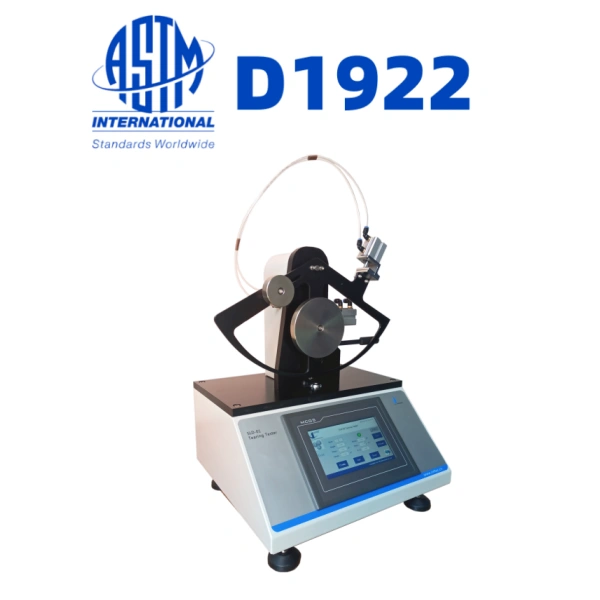
Elmendorf Tear Test: A Reliable Method for Measuring Tear Strength
Le Test de déchirure d'Elmendorf plays a key role in ASTM D1922, providing an effective way to determine how much force is required to propagate a tear through a specimen. The test involves a precisely calibrated pendulum that swings through an arc to tear the material, with the energy loss being indicated on a scale. The force needed to continue the tear process is directly related to the material’s résistance à la déchirure.
This test method is ideal for films, including films d'emballage, commonly used in packaging applications. The Elmendorf tear tester provides a clear and repeatable method for testing materials’ resistance to tearing, ensuring that manufacturers meet the required standards for durability and performance.
Significance of ASTM D1922 in Assessing Film Strength
ASTM D1922 is essential for determining the tear strength of films, particularly when evaluating materials for packaging applications. The test method helps to rank the tearing resistance of various plastic films and thin sheeting. For materials like films d'emballage, the ability to resist tearing is crucial in maintaining product integrity throughout the supply chain.
The test results help manufacturers and quality control personnel understand the film strength under typical conditions. It is widely used for specification acceptance testing and for evaluating the suitability of materials for specific applications.
Key Factors Influencing Tear Strength of Film
Le résistance à la déchirure of films is influenced by several factors:
- Composition du matériau : Different polymers like polyethylene (PE), polypropylene (PP), and polyester (PET) exhibit varying levels of résistance à la déchirure due to their molecular structures and processing methods.
- Épaisseur: Thicker films tend to have higher tear resistance. However, there is not always a direct linear relationship between épaisseur du film et résistance à la déchirure. ASTM D1922 results are usually compared for films of the same thickness for accurate comparisons.
- Orientation: Many films, particularly biaxially oriented ones, exhibit anisotropic behavior. This means that their tear strength may differ depending on the direction of the tear relative to the machine direction. The Test de déchirure d'Elmendorf helps capture these directional differences, providing accurate tear strength data.
- Elongation: Materials that elongate significantly during tearing can show reduced reproducibility in test results, especially for more extensible films. ASTM D1922 recognizes these challenges, particularly for materials with high elongation or orientation.
Importance of Tear Strength in Packaging
For packaging materials, the tear strength of film is of paramount importance. Films that tear easily can compromise the product’s protection, leading to contamination, spoilage, or product loss. Packaging materials, especially those used for food, medical, and consumer goods, must be tough enough to resist accidental punctures and tears during handling and transportation.
For example, in food packaging, materials must provide résistance à la déchirure to ensure that they do not rupture under normal handling. Similarly, medical packaging films need to be tear-resistant to maintain sterility and ensure that they are easy to open without damaging the contents.
Why Use Cell Instruments’ Tear Testing Solutions?
For businesses seeking to ensure the tear strength of wrap films and other plastic films meet industry standards, Instruments cellulaires provides advanced tear testing equipment, including the Elmendorf tear tester. Our equipment is designed for precise measurement of résistance à la déchirure, helping companies maintain the highest standards of quality control.
By using Cell Instruments’ testing solutions, manufacturers can achieve reliable, reproducible results that comply with ASTM D1922 standards, ensuring that their packaging materials offer the durability required for both everyday use and challenging environments.
ASTM D1922 is the definitive method for measuring the tear strength of films, with the Test de déchirure d'Elmendorf offering a controlled and accurate way to assess the material’s resistance to tearing. By understanding the factors that influence film strength, manufacturers can optimize their packaging materials to meet the required performance standards, ensuring product safety and quality.

 Български
  Čeština
  Dansk
Dansk  Ελληνικά
  Eesti
Eesti  Suomi
Suomi  Magyar
  Bahasa Indonesia
  Lietuvių kalba
  Latviešu valoda
  Norsk bokmål
  Nederlands
  Polski
  Română
  Slovenčina
  Slovenščina
  Svenska
  Türkçe
  Українська